 Read
ReadBook One of ten · Season One: Nothing Happens Here
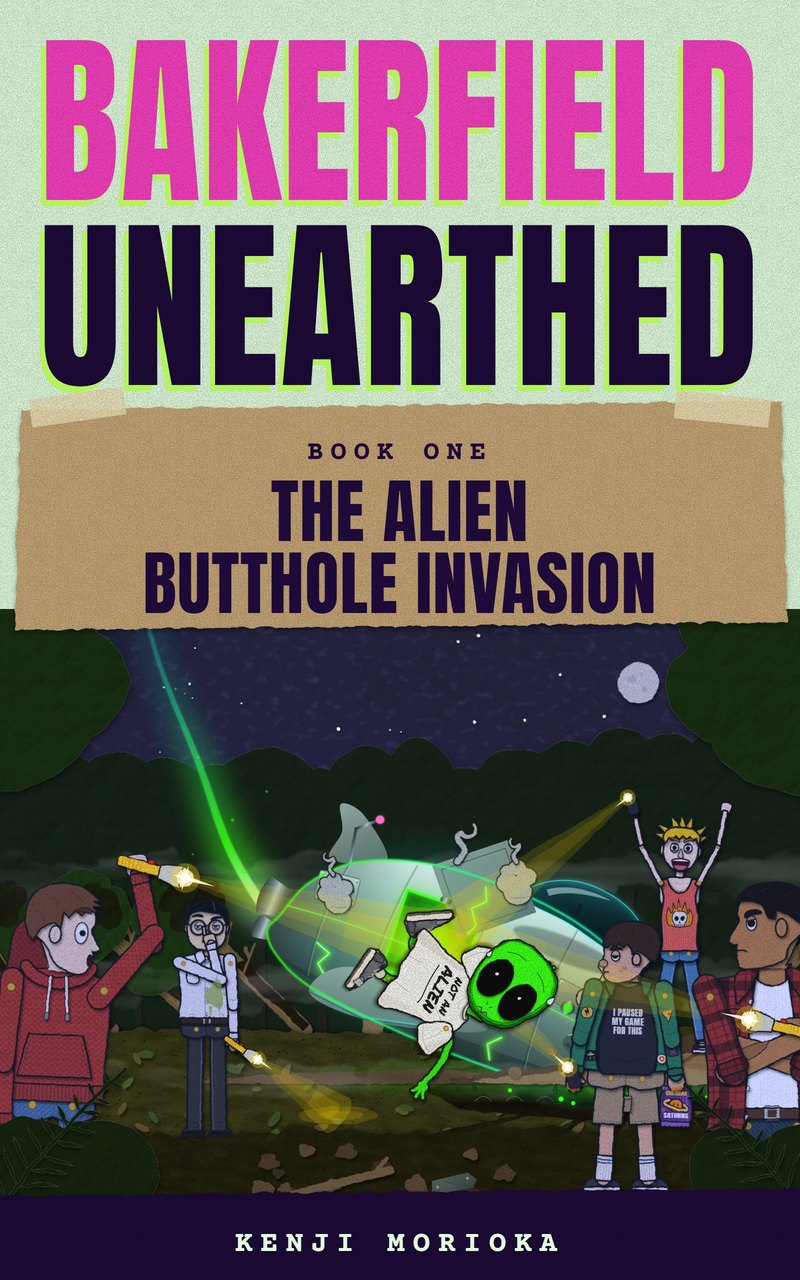
The Alien Butthole Invasion
First contact went surprisingly well. Second contact kicked in the garage door.
Bakerfield, Ohio. Population twelve thousand. Motto: Why Not? Nothing has happened here since the Roast Ranch caught fire.
Then, one Tuesday night in October, a spaceship the size of a sedan comes down in the woods behind Sam Whitmore’s house, and its pilot climbs out: three and a half feet of bright green government clerk from the planet Zogar, who falls on his face and begs five total strangers not to probe him. He crashed because he was watching reality television. He needs fuel. He needs a disguise. He needs somewhere to hide a spaceship before morning.
Sam has a garage. Sam also has four friends: one who never stops eating, one who never stops shouting, one who is the only adult in any room, and one who is already doing the math on how much prison this is.
Up on the ridge, the only federal agent in Ohio has waited eleven years for something to happen.
Tonight, it does.
Not on sale yet
Free sample · the first pages of Book One
Free sample · Book 1
Listen to the free sample
Browser narration reads the exact Cold Open below. Voices depend on your browser.
Choose narration or play the captioned slideshow.
Listen with your browser’s voice, follow the captions, or read the complete printed sample below.
Book One Cold Open
Space was beautiful, infinite and humbling, and for most of its history it had managed all three without help. Then, a little after nine o’clock on a Tuesday night in the middle of October, by the clocks of a place it had not yet noticed, something small crossed one corner of it and began to lower the average.
The ship was about the size of a sedan, and roughly the shape of one, if a sedan had been grown instead of built: a seedpod of green-gray metal with two stubby wings and a ribbed hull. Light moved under the hull in slow pulses, a green so pure it looked lit from inside, which it was. Behind it hung a fine green contrail, and on a better-flown craft the contrail would have been straight. This one wobbled. It dipped. It corrected, overcorrected, dipped again and wandered off to the left for a while, writing across the dark the signature of something that was not, in any sense a navigator would recognize, being piloted.
The pilot was watching television.
He sat in a chair shaped for somebody with a very large head, which was lucky, because he had one: an enormous smooth oval tipped at the angle of total absorption, its two black eyes holding the hologram the way a pond holds the moon. He was three feet six inches tall and bright green, the green laid on in more layers than were strictly necessary, as if whoever made him had kept adding coats to be sure. Three fingers of one hand were closed around a tube of synthesized dinner that he had forgotten to eat. His name was Zog. He was a Level-3 Observer of the Department of Interplanetary Observation, and he had not looked out of the windshield in some time.
Above the dashboard, in a column of clean blue light, four sisters sat on four white sofas in a house the size of a regional airport. It was Montclair Money, and on Zog’s planet it was studied as high art. The eldest sister was explaining contouring. Zog knew about contouring. He had filed a report on contouring, with diagrams, in triplicate. What he did not know, what nobody on his entire world yet knew, was how the second sister began her day, and she had just told the camera, with one hand flat on her heart, that she was finally ready to share.
On his left wrist a slim band of the same green-gray metal as the hull carried a small dial with four marks on it. He had never turned it past the first.
“Fuel reserves critical,” said the ship.
The voice came from everywhere at once, clean and synthetic, with a faint harmonic under it. It belonged to the ship’s intelligence, whose name was Z.A.R.A., and who had flown Zog across more of the galaxy than either of them had planned.
“Mm,” said Zog.
“Autopilot has selected the nearest Zogarium source.”
“Mm.”
“Since you ask, it’s a Level 2 pre-contact planet. Official rating: Mildly Amusing, Do Not Engage. That’s the least interesting inhabited world in this arm of the galaxy, and you’ve spent eighty years watching its television.”
The second sister drew a breath. “Shh,” said Zog.
For nine seconds nothing aboard changed. Then the light went, all at once, from calm to red, and a klaxon began. It was a Zogarian klaxon, and therefore polite, but it had been built by a civilization that considered persistence a virtue, and it kept going.
“Collision alert,” said Z.A.R.A. “Collision alert. You are on a direct trajectory with a Level 2 pre-contact planet.”
Zog did not look up. “Shh! She is about to reveal her morning routine!”
“Your morning routine will involve burning alive in an atmosphere in approximately fourteen seconds.”
On the column of light, the second sister smiled the private smile of a woman about to monetize her breakfast. Zog, with the part of his attention that was not busy with her, which was small and located somewhere near the back, noticed that the windshield had changed color. He glanced at it.
The windshield was full of a planet, and the planet was coming up. Dark land, flat land, trees by the million, and a scatter of small yellow lights among them strung along curving streets like crumbs left on a plate. In the middle of the view, lit from below by one failing lamp, stood a water tower with the name of a town painted around its belly. One of the letters was missing. Nobody had come to put it back, which told a trained observer most of what there was to know about the place.
“Oh, triplicate,” said Zog.
On Zogar, where every form came in three copies and every copy was filed, it was the filthiest word in the language.
The ship hit the air, and the air hit back. The hull shook. The green light under it flared white, and fire came curling up over the wings in long orange tongues, and a tray of instruments that had not moved in years stood up and walked off its shelf. The tube of dinner left Zog’s hand and went, with great purpose, to the ceiling. In the blue column the four sisters shivered, tore into stripes, and knitted themselves back together long enough for the second one to lean toward the camera and say, “Every morning, the very first thing I do is—”
The column went empty. It held its shape for one more second, blue and full of nothing, and then it was gone.
Zog had both hands on the dashboard. He was not steering. He had never, in any meaningful way, been steering.
“NO,” he said. “NOT MONTCLAIR MONEY! ANYTHING BUT MONTCLAIR MONEY!”
The show went out. The planet did not.
Zog's Log
Transmission encrypted. Mark Book One as read to decode it. It contains spoilers.
Earth Day One.
The humans are not what I expected. They are crude. They are loud. One of them, the yellow-haired one, has the vocal modulation of a malfunctioning alarm system. He has told me his name more than once, and each time something louder has happened at the same moment, so I do not yet know what it is. Another eats constantly and says almost nothing of consequence, and yet everything he says has consequence. He produced a bag of orange food from a garment that contained no bag. I have not determined how. The large one with the flannels stood between me and a government man. The smart one spilled a beverage on himself. It was the correct color. The average one, Sam, gave me his garage.
At ignition my ship expelled compressed gases, which is normal. The yellow-haired one required me to describe this as “farted.” I have complied, and I record it here so that the record is complete. My ship’s intelligence then informed the humans that this is my fourth incident. I wish the record to show that it is my first garage. The folded meat bread called “taco” is a culinary revelation. I have not yet learned how the morning routine ends.
The disguise has now been tested on four adult humans. Three passed. One of them, in a park, looked at me for two full seconds and returned to his newspaper. My Department rates this the least observed place on the planet. The rating is accurate. I find it liberating. The fourth adult did not pass. He has been placed in a clearing on the hill, where he will remain for twenty-eight days. His lower garments were removed by gravity during containment, which I did not intend. He says it is a tactical position. I believe him. It is a very good ball.
On Zogar, a citizen who assists another citizen at no benefit to himself is logged as an error in resource allocation, and the error is corrected. Since nine o’clock last night, five humans have made this error continuously. They made it with a wagon, three skateboards and then two, a shopping cart, a shovel, a vehicle that opens only from the outside, and eleven dollars. Nobody corrected them. I believe the Earth word for it is friendship. I have filed the word provisionally, pending review.
I was told Earth was primitive. I was told humans were entertainment. Nobody told me they would be… kind. Clumsy, profane, and kind. I have decided to stay.
I remain disguised. The shirt continues to work.
End transmission.
The next chapter
Future editions
Read the free sample now. EPUB, paperback and hardcover editions are planned; release dates and prices will appear here when they are ready.
EPUB
A digital edition planned for your ereader.
PlannedPaperback
A paperback edition planned through Lulu.
PlannedHardcover
A hardcover edition planned through Lulu.
Planned
Future print editions are planned for Lulu checkout. Availability and prices will be confirmed before ordering opens.
Back to the free sample